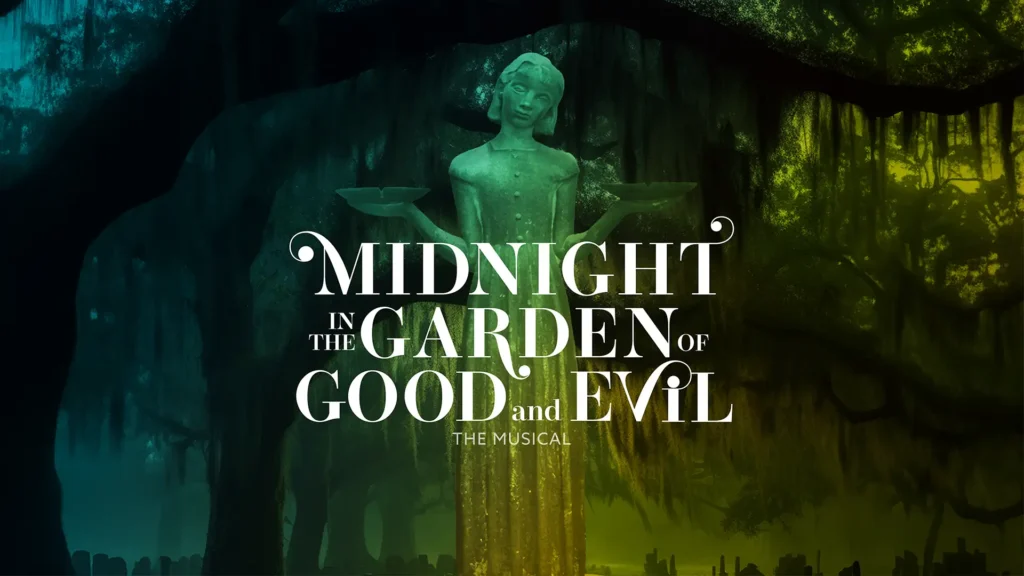
Why Midnight in the Garden of Good and Evil
Some stories refuse to fit neatly into a single genre.
John Berendt’s Midnight in the Garden of Good and Evil is at once true crime, Southern Gothic, social history, comedy of manners, and meditation on identity. For more than three decades, readers have been captivated not simply by its sensational murder trial, but by the remarkable community that surrounds it. Savannah becomes a world where elegance coexists with eccentricity, where appearances conceal hidden lives, and where every character seems to exist somewhere between myth and reality.
That complexity is precisely what makes the story so compelling for the musical stage.
Unlike traditional mysteries, Midnight is less interested in solving a crime than in revealing a society. The real drama lies in the collision of old traditions and changing values, in a city negotiating questions of class, race, sexuality, reputation, and belonging long before those conversations became commonplace.
Music has the unique ability to transform atmosphere into emotion, giving voice to characters whose public personas often conceal profound loneliness, resilience, humor, and desire. Savannah itself becomes a singing character: a city of beauty and decay, hospitality and judgment, ghosts and reinvention.
The Case for This Story
Few nonfiction books have entered American culture as completely as Berendt’s. A Pulitzer Prize finalist that remained on The New York Times Best Seller list for an extraordinary 216 weeks, the book transcended the true-crime genre by creating one of the most vivid portraits of an American city ever written. Its enduring popularity led to a feature film and, now, decades later, inspires a major musical adaptation with a book by Taylor Mac and an original score by Jason Robert Brown, which premiered at Chicago’s Goodman Theatre in 2024 before being developed for Broadway.
What distinguishes the musical is not that it seeks to tell Berendt’s story with songs. It embraces the theatricality that was always embedded within the material. The citizens of Savannah are larger than life. Their rituals, rivalries, celebrations, and secrets invite music not as embellishment but as revelation.
This project reflects an enduring belief that great theatre often emerges from stories that resist easy categorization. We are drawn to works that combine entertainment with complexity and contradiction: productions that invite audiences into richly imagined worlds while asking enduring questions about justice, identity, community, and the stories people tell to survive.
Why It Matters
What makes Midnight in the Garden of Good and Evil endure is not the verdict at the center of the trial.
It is the recognition that every community constructs its own mythology. Every city has its gatekeepers, its outsiders, its legends, and its ghosts. Berendt understood that the truth of a place is rarely found in official histories; it lives in its people, their contradictions, and the stories they choose to preserve.
The musical captures that same spirit. Rather than reducing Savannah to a backdrop for a crime, it celebrates its humanity in all its eccentricity. The result is a work that is funny, mysterious, unsettling, and unexpectedly moving.
It reminds us that beneath every beautiful façade lies a more complicated truth, and that those are the stories worth telling.
The artistic argument isn’t “it’s a famous true-crime story.” Midnight is an American myth about reinvention, performance, outsiders finding community, and the tension between preserving tradition and embracing change. These are timeless human themes, which align most powerfully with our producing mission.